
WHY DESK WORKERS GET KNEE PAIN - AND WHAT TO DO ABOUT IT
You don’t play sport. You barely run. So why does your knee hurt? Here’s what hours of sitting actually does to your knee - and how to fix it.
One of the most puzzled expressions I see in our Oakville clinic belongs to the patient who sits down, looks at me, and says some version of: “I don’t even do anything physical, I sit at a desk all day. Why does my knee hurt?”
It’s a completely fair question. And the answer is a little counterintuitive: sitting for long hours isn’t neutral for your knee, it’s actively stressful - just in ways that are slow and cumulative rather than sudden and obvious.
Here’s what’s actually happening, and more importantly, what you can do about it.
The 4 Reasons desk work hurts your knees
Reason 01 - Prolonged sitting compresses the patellofemoral joint
When your knee is bent at roughly 90 degrees - the typical seated position - the kneecap (patella) is pressed against the femur with sustained, low-grade force. For an hour, this is no problem. For six to eight hours a day, five days a week, year after year, that sustained compression becomes a source of chronic irritation for many people. The cartilage under the kneecap isn’t designed for that king of unrelenting static load.
reason 02 - sitting tightens your hip flexors - and your knee pays for it
The hip flexors shorten when held in a flexed position for hours at a time. Tight hip flexors pull the pelvis into an anterior tilt, which changes the alignment of the entire lower limb chain. This altered alignment shifts how force is distributed through the knee - particularly affecting how the kneecap tracks in its groove. Poor patellar tracking is one of the most common causes of anterior knee pain in non-athletic patients.
reason 03 - your glutes switch off
Sustained sitting inhibits gluteal activation - the muscles literally become less responsive the longer you sit. Since the glutes are the primary stabilizers of the hip and pelvis, their inhibition means the knee has to work harder to compensate during any standing or walking activity. A 2km lunchtime walk that should be effortless becomes disproportionately stressful on the knee because the hip stabilizes aren’t pulling their weight.
reason 04 - deconditioning makes everything worse
Sedentary desk work gradually reduces overall lower limb strength and neuromuscular control. The knee becomes increasingly reliant on passive structures - ligaments, cartilage, the joint capsule - rather than the active muscular support that protects it. Small loads that would be trivial for a conditioned body become meaningful stress on a deconditioned one.
The pattern we see most often
The typical desk-worker knee patient at our clinic describes pain that’s worst after sitting for long periods - stiffness and achiness when standing up, pain going down stairs, and sometimes a dull ache that builds through the afternoon. Weekends often feel better because they’re moving more. Mondays feel worse. Sound familiar?
This pattern almost always points to patellofemoral pain syndrome - irritation under or around the kneecap driven by the combination of sustained compressed, altered hip mechanics, and reduced muscular support.
the good news
Desk-worker knee pain is among the most responsive types of knee pain we treat. Because it’s driven primarily by muscular and postural factors - not structural damage - it responds very well to targeted physiotherapy and relatively simple lifestyle changes. Most patients see significant improvement within 4-6 sessions. Learn about these seven steps to reduce your knee pain.
What Actually Fixes It
Rest helps temporarily but doesn’t address the cause. Here’s what we actually do:
Reactivates the glutes:
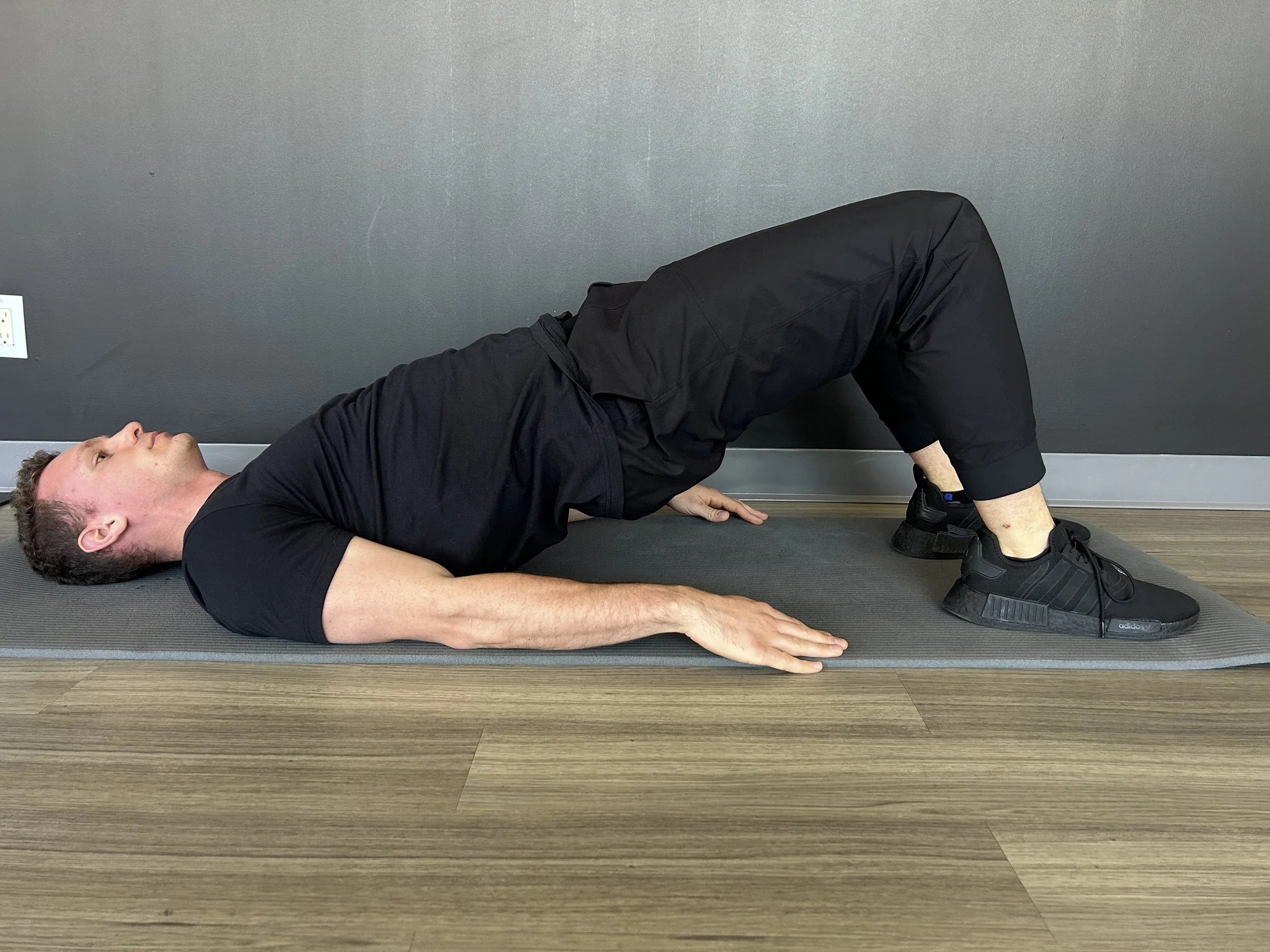
Glute bridges, clamshells, and lateral band walks done consistently - even 10 minutes daily - begin to reverse the inhibition pattern that sitting creates. This is always the foundation of our desk-worker knee programs. Learn more about our knee pain rehab in Oakville.
Stretch and mobilize the hip flexors:
A daily kneeling hip flexor stretch held for 60-90 seconds per side, done first thing in the morning and after work, makes a measurable difference to patellar tracking over time. It sounds too simple. It consistently works.
Break up sitting with movement:
Standing or walking for even 2-3 minutes every 45-60 minutes significantly reduces the cumulative compression load on the patellofemoral joint. A simple phone alarm is all it takes. This alone reduces symptoms for many patients
Assess your chair and desk setup:
Knee angle, desk height, and monitor position all affect lower limb posture. A quick ergonomic review - something we can help guide - often reveals simple adjustments that reduce daily load on the knee significantly.
Progressive strengthening:
Building quad, hamstring, and hip strength through a progressive program addresses the deconditioning component. This isn’t about becoming an athlete - it’s about giving your knee the muscular support it needs to handle the demands of daily life comfortably. Read about knee strengthening exercises and what a physiotherapist actually prescribes.
when to come in rather than self-manage
If your knee is swelling, if the pain is interfering with sleep, if you’re limping, or if self-directed stretching and movement breaks haven’t produced improvement after 3-4 weeks - book an assessment. There’s a spectrum of desk-worker knee pain, and some presentations need hands-on treatment to resolve.
Knee pain from desk work is preventable and treatable. You don’t have to accept it as the price of a professional career. At Elevate, we work with Oakville professionals every week who’ve made a few targeted changes and gone from dreading their commute home to barely noticing their knee at all.
Book a Physiotherapy Assessment
Or call us at (289) 835-2949
710 Dorval Drive #520, Oakville
