
ACL RETURN TO SPORT: THE TIMELINE WE ACTUALLY USE
One of the most common questions we get from ACL patients at our Oakville clinic is some version of: “My surgeon said 6 months. Does that mean I can play in my September season?”
The honest answer is: maybe. But not because of the calendar. Because of where your body actually is at that point.
ACL recovery has a timeline, but it isn’t a schedule. Return to sport is determined by criteria - specific strength, movement, and psychological benchmarks that your body needs to meet before it’s safe to return to the demands of cutting, pivoting, and contact sport. The calendar is a rough guide. The criteria are the real test.

Here’s the phase-by-phase breakdown we use at Elevate, and what we’re actually looking for at each stage.
WHY THIS MATTERS MORE THAN YOU THINK
Athletes who return to sport before meeting criteria have significantly higher re-tear rates. One large meta-analysis found that returning before 9 months was associated with dramatically increased re-injury risk regardless of how “ready” the athlete felt. Time is a necessary but insufficient condition.
Weeks 1 - 3: Phase 1 - Acute Recovery
The first priority after surgery is simple: get the swelling down and get the quad firing again. Quad inhibition - where the brain essentially “turns off” the quadriceps in response to joint trauma - is one of the most under appreciated barriers to ACL recovery. A knee that can’t straighten fully and a quad that won’t activate properly will compromise every phase that follows.
At this stage we’re working on full passive extension, managing swelling with elevation and ice, and beginning gentle quad seats and straight leg raises. We’re also focused on protecting the graft during its most vulnerable window.
Weeks 4 - 12: Phase 2 - Strength Foundation
This is where the real work begins. The ACL graft goes through a process called ligamentization - essentially, the graft remodels to function like a regular ligament - and this process takes months. During this window, we’re building the muscular armour around the joint: quad strength, hamstring strength, glute strength, and hip stability.
Key exercises in this phase include leg press, Romanian deadlifts, step-ups, and early single-leg work introduced progressively. We’re targeting at least 70% symmetry between the surgical and non-surgical leg before advancing.
Weeks 12 - 20: Phase 3 - Running & Power
Return to running is a milestone patients are eager to hit - and rightfully so. But we don’t clear running based on time. We clear it when the patient can demonstrate adequate single-leg strength and control to absorb the impact of running safely. Typically this means passing a single-leg squat assessment and demonstrating no pain or swelling with a walk-to-jog progression.
Once running is established, we layer in plyometric training - jump landings, box jumps, lateral hops - to rebuild the elastic strength and power the joint needs for sport.
Months 5 - 7: Phase 4 - Agility & Sport-Specific Movement
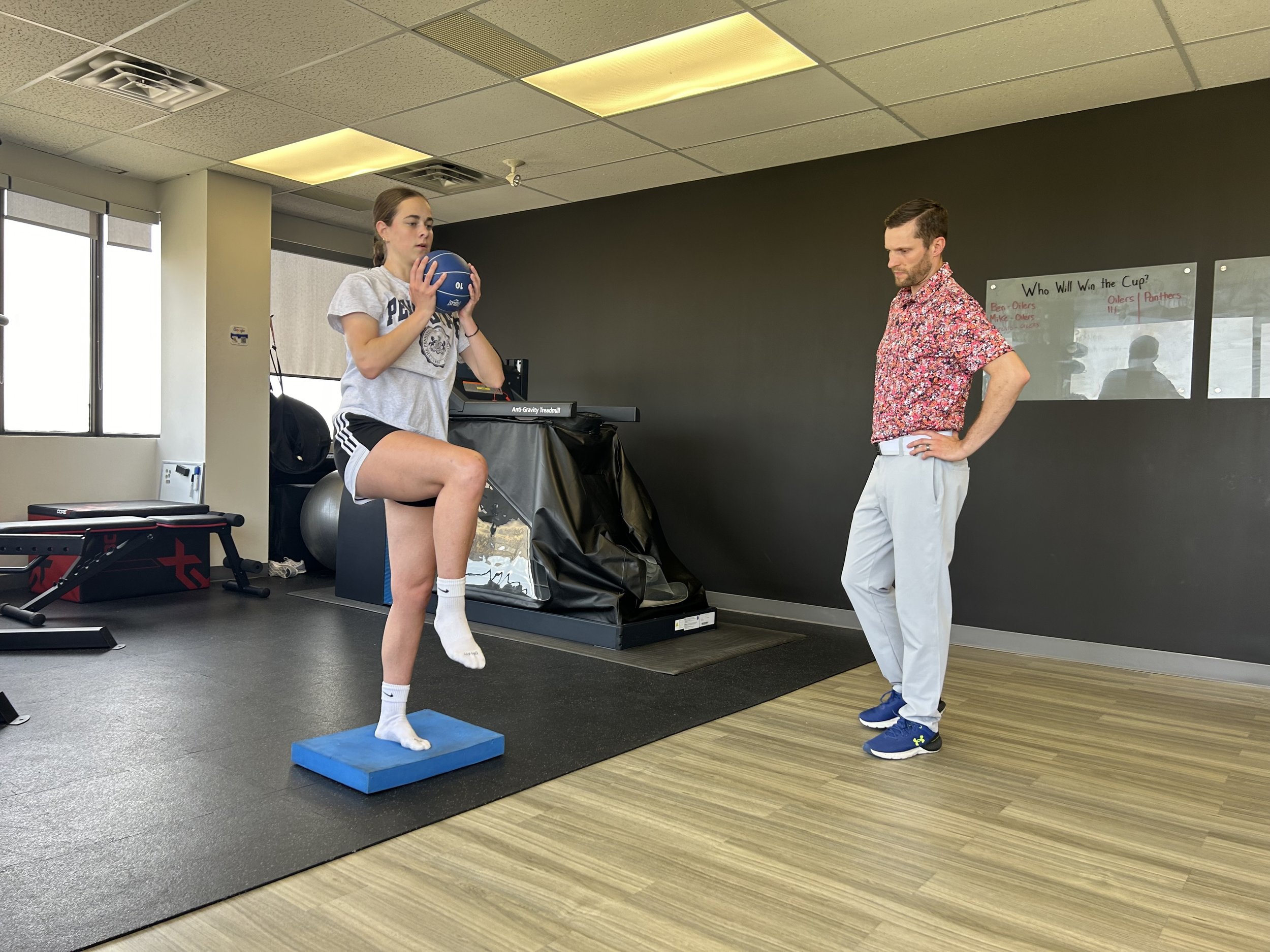
This the phase that most generic timelines underemphasize. Cutting, change of direction, sport-specific movement patterns - these are trained systematically, not just implied by returning to practice. We use agility ladders, reactive drills, and sport-specific scenarios to expose and address any movement compensations before the patient returns to an uncontrolled sport environment.
We’re also doing formal strength testing in this phase - ideally isokinetic testing comparing the surgical to non-surgical limb - aiming for 90% of greater symmetry before return to sport is recommended.
Months 8-12+: Phase 5 - Return to Sport & Psychological Readiness
The final phase is both physical and psychological. We use objective measures such as force plate testing and functional movement screens to assess psychological readiness - fear of re-injury, confidence in the knee, and trust during explosive movements. Research consistently shows that athletes who score below threshold on psychological readiness have higher re-injury rates even when their physical metrics are excellent.
Full return to unrestricted sport - contact, competition, game intensity - typically happens between 9 and 12 months for most of our patients. Some athletes who had more complex injuries, slower graft maturation, or who are returning to very high-demand sport take longer. That’s not failure. That’s appropriate caution.
THE CRITERIA THAT MATTER MOST
Before we clear any ACL patient for full return to cutting sport, they need to meet all of the following: 90%+ limb symmetry index on strength testing, passing scores on hop tests, psychological readiness threshold met, and no pain or reactive swelling during sport-specific training. Time alone is never sufficient.
What Slows ACL Recovery Down
In our experience at Elevate, the most common reasons ACL recovery stalls are: insufficient quad strength in the early phases, returning to running too early and developing reactive swelling that sets progress back, skipping the plyometric phase because the athlete “feels fine,” and neglecting psychological readiness entirely.
Having a physiotherapist guiding your recovery - not just checking in occasionally - makes an enormous difference to how efficiently you move through these phases and how confidently you return to sport at the end.
Recovering from ACL Surgery in Oakville?
Whether you’re one week post-op or six months in and feeling stuck, our team at Elevate can assess where you are in your recovery and build a clear, criteria-based plan to get you back on the field safely.
Book Your ACL Rehab Assessment
Call us at 289-835-2949
