
You step off a curb, plant your foot on an uneven patch of grass, or push off hard on the tennis court, and your ankle rolls under you. Several days pass by, the swelling has gone down and the pain is fading, so you get back to life. It feels like the story is over.
But it often isn't.
Ankle sprain proprioception exercises, the balance and body-awareness work that finishes the job, are what separate a one-time roll from an ankle that keeps giving out. At Elevate Rehabilitation in Oakville, we see this all the time, and the fix is simpler than most people expect.
How Common Are Ankle Sprains?
Ankle sprains are among the most common sports injuries, and they show up most in teens and young adults. One large US study found that people aged 10 to 24 account for more than half of all ankle sprains, with the highest rates at ages 15 to 19. But you do not have to be an athlete. A misstep on an icy Oakville sidewalk or a wobbly stair can do it too.
The tricky part is what comes next. Research reports that up to 40 percent of people with a first lateral ankle sprain go on to develop chronic ankle instability within a year, meaning a joint that feels loose, rolls again, or never feels quite right.
What Happens in a Lateral Ankle Sprain?
A sprain is an injury to a ligament. Ligaments are tough bands that connect bone to bone and keep your joint steady. The outer (lateral) side of your ankle has three of them, and the front one, the anterior talofibular ligament, is the one injured most often.
The classic mechanism is a roll. Most lateral sprains happen right as your foot goes from "in the air" to "on the ground." The foot turns inward and twists while pointing down, and the outer ligaments get stretched past their limit. This can happen when you land from a jump on someone else's foot, change direction fast, or step on a curb or uneven surface. Sports like basketball, soccer, volleyball, and tennis, with all their sudden stops and side-to-side cuts, are common settings.
Why Proprioception Matters
Proprioception is your body's sense of where each joint is in space, without looking. Tiny sensors in your muscles, tendons, and joints send constant updates to your brain, so your ankle can adjust in a split second when the ground shifts.
After a sprain, those sensors and the muscles that respond to them get disrupted. Your ankle may heal on the outside but still react more slowly. That delay is a big reason it rolls again. Balance training teaches your brain and muscles to react quickly, so the joint protects itself. It is a bit like re-tuning a car's steering after a bump.
A 2015 systematic review in the Journal of Science and Medicine in Sport found that proprioceptive training cut the risk of ankle sprains by about 35 percent in sporting groups, and by about 36 percent in people who had already had a sprain. As we tell patients, balance training prevents future sprains. Treat it as part of recovery, not an extra.
The Three Phases of Recovery
Every ankle is different, and the timelines below are rough guides for a mild to moderate sprain. More severe sprains take longer. Your physiotherapist can grade your sprain and set your pace.
Acute (first few days to 1 week): protect, calm swelling, keep gentle motion
Subacute (about weeks 1 to 4): restore motion, start strength and balance
Strengthening and return to play (about weeks 4 to 12): build power, challenge balance, return to sport
Phase 1: Acute (Protect and Calm Things Down)
Right after the injury, your ankle is sore, swollen, and guarded. The aim is to protect it without shutting it down completely.
Rest it from painful activities, but keep moving what you comfortably can
Use ice, compression, and elevation to help manage swelling
Walk as pain allows, with a brace, tape, or crutches if needed
Do gentle ankle pumps and "draw the alphabet" with your foot
Get it assessed early. We check for a fracture using simple rules, such as whether you can take four steps and whether there is bone tenderness, and we test the ligaments with hands-on tests like the anterior drawer. If you cannot put weight on it at all, get checked right away.

Phase 2: Subacute (Get Moving and Start Rebuilding)
As pain and swelling ease, motion returns. This is where recovery usually stalls if you stop too soon.
Calf stretches and gentle joint mobilization to restore range
Light resistance band work for the ankle muscles
Standing weight shifts, then single-leg standing on flat ground
Soft tissue work and taping or bracing for comfort and confidence
Phase 3: Strengthening and Return to Play
Now we turn up the challenge. Your ankle needs strength, balance, and the ability to react fast on unstable ground. We build toward jogging, hopping, cutting, and your sport, and we only move forward when you can do each step with good control and no pain. A good test is simple: can you balance, hop, and change direction on the sore side as well as on the other?
Five Exercises for Ankle Support and Balance
Do these near a wall or counter so you can steady yourself, and wear supportive shoes unless told otherwise. Stop if you feel sharp pain. Start with the easier versions and progress when each feels steady.
1. Single-Leg Stand (Solid, Then Foam)
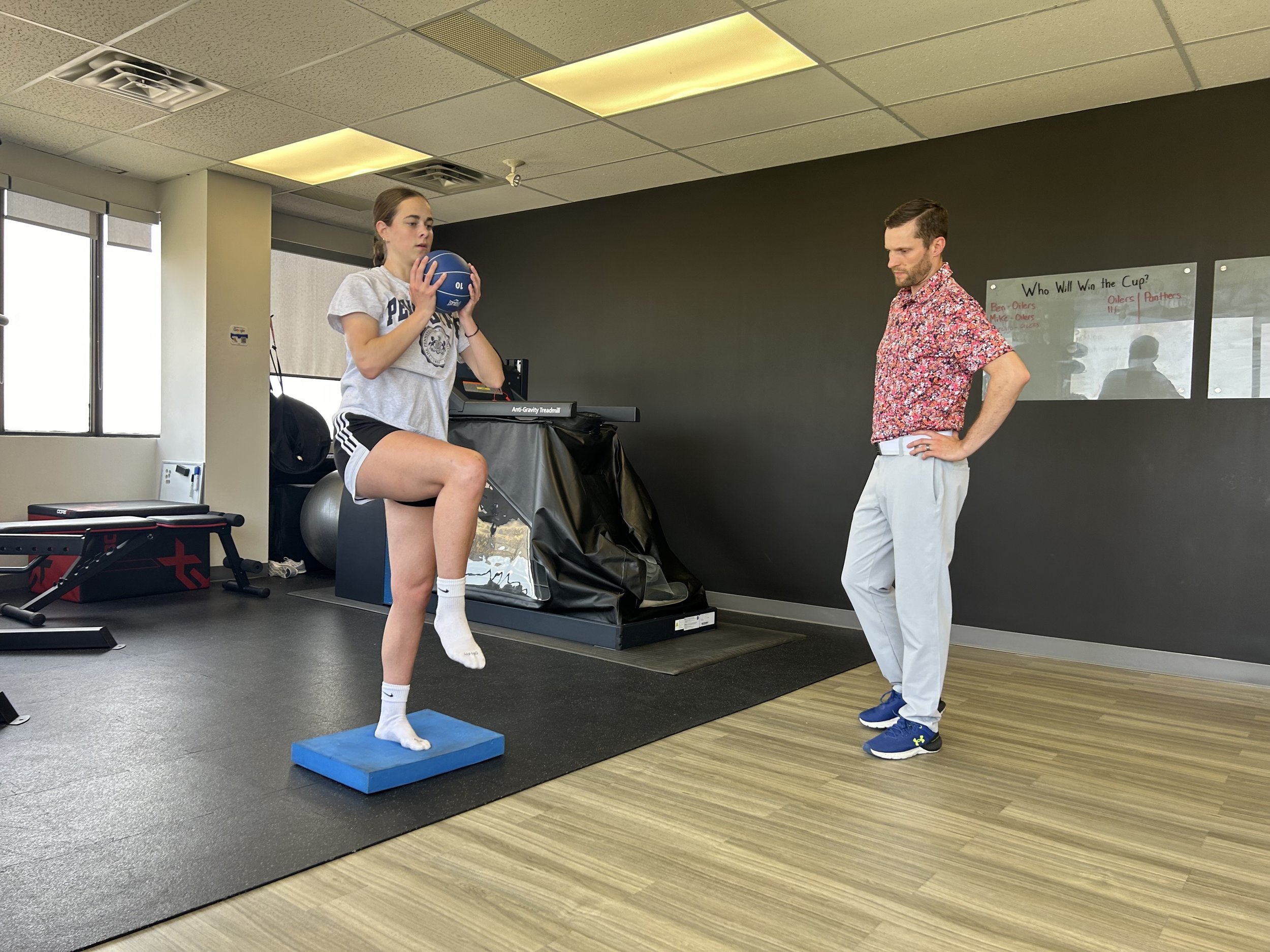
Stand on your sore leg with a slight bend in the knee and hold for 30 seconds, keeping your ankle from wobbling in or out. Repeat 3 times. When it feels easy, move to a foam pad or folded towel, then try closing your eyes while someone stands nearby.
2. Resistance Band Four-Way Ankle
Sit with your leg out and a loop of resistance band around your forward foot. Move your ankle slowly in four directions: toes up, toes down, foot in, and foot out. Do 10 to 15 reps each way, and take 3 seconds on the return, since controlling the way back builds strength. The outward direction trains the muscles that guard against rolling.
3. Wobble Board Activities
Stand on a wobble board with both feet, holding on, and gently tip it in all directions without letting the edge touch the floor. Progress to circles, then to single-leg standing on the board. Add a ball toss for an extra challenge once you feel steady.
4. Lateral and Forward Step-Ups on a Bosu Ball
Place a Bosu ball dome-side up beside a counter. Step up sideways with your sore leg, balance briefly on top, and step down slowly. Do 8 to 10 reps, then repeat stepping forward. Because the dome moves, it asks your ankle to react to an unstable surface. Save this one for later in rehab, once simpler balance work feels easy.
5. Standing Cone Taps
Stand on your sore leg beside a counter with 4 to 5 cones or small cups arranged in an arc in front of you. Use your other foot to tap each one, one at a time, without losing balance. Move the cones farther away to increase the challenge. This trains balance and control while your weight is on the healing ankle.
Do Not Skip the Last Phase
Most people stop rehab as soon as the pain is gone. That is the moment your ankle is most at risk. Pain fades long before balance and strength are back, and the research is clear that the balance work lowers your chances of a repeat sprain.
At Elevate Rehabilitation in Oakville, our team guides you through each phase, from the first swollen days to confidently getting back to your sport. If you have rolled your ankle, or it keeps rolling, reach out to book an assessment and build a plan that gets you back on solid ground.
References
Waterman, B. R., Owens, B. D., Davey, S., Zacchilli, M. A., & Belmont, P. J., Jr. (2010). The epidemiology of ankle sprains in the United States. The Journal of Bone and Joint Surgery, American Volume, 92(13), 2279–2284. https://pubmed.ncbi.nlm.nih.gov/20926721/
Delahunt, E., & Remus, A. (2019). Risk factors for lateral ankle sprains and chronic ankle instability. Journal of Athletic Training, 54(6), 611–616. https://doi.org/10.4085/1062-6050-44-18
Doherty, C., Bleakley, C., Hertel, J., Caulfield, B., Ryan, J., & Delahunt, E. (2016). Recovery from a first-time lateral ankle sprain and the predictors of chronic ankle instability: A prospective cohort analysis. The American Journal of Sports Medicine, 44(4), 995–1003. https://doi.org/10.1177/0363546516628870
Schiftan, G. S., Ross, L. A., & Hahne, A. J. (2015). The effectiveness of proprioceptive training in preventing ankle sprains in sporting populations: A systematic review and meta-analysis. Journal of Science and Medicine in Sport, 18(3), 238–244. https://doi.org/10.1016/j.jsams.2014.04.005