
Do I Need ACL Surgery? What We Tell Patients First.
An ACL tear is one of the most feared sports injuries. But surgery isn’t always the answer. Here’s how we help Oakville make the right decision for their situation.
You heard the pop. Your knee gave out. An MRI confirmed what you feared: a torn ACL. The first question almost everyone asks next is the same - "Do I need surgery?
"It's a reasonable question. But it's also the wrong first question. The better question is: "What do I need to get back to the life and sport I love and is surgery the best path to get there?"
At Elevate Rehabilitation in Oakville, we work with ACL patients at every stage - from day one after injury through return to sport. And the honest truth is that surgery is the right choice for some patients and unnecessary for others. Here's how we think through it.
IMPORTANT NOTE
This post is for educational purposes and does not replace an individualized assessment. ACL management decisions should be made in partnership with your physiotherapist and orthopaedic surgeon. Every injury and every patient is different.
What an ACL Tear Actually Means
The anterior cruciate ligament (ACL) is one of four major ligaments stabilizing your knee. It runs diagonally through the middle of the joint and is primarily responsible for controlling forward movement of the tibia and rotational stability - the kind of control you need when cutting, pivoting, landing, or changing direction quickly.
When it tears, it doesn't grow back on its own. But that doesn't automatically mean you need a surgeon to reconstruct it. The relevant question is: how much rotational stability does your knee need for the activities that matter to you?
The Case for Conservative Management (No Surgery)
Research over the past decade has significantly shifted how clinicians think about ACL tears. A landmark Scandinavian study - the KANON trial — found that for many patients, structured physiotherapy produced outcomes comparable to surgery at two-year and five-year follow-up. A subset of patients can achieve full return to sport without ever going under the knife.
These patients are sometimes called "copers" - people whose neuromuscular system adapts well enough to compensate for the missing ligament. Identifying whether you're a coper is something we can begin to assess within the first few weeks of injury.
Conservative management tends to be a strong option when:
FACTOR 01 - Your sport or activity doesn't involve high-demand pivoting
Cyclists, swimmers, rowers, and even runners can often return to their sport without ACL reconstruction. The ligament's rotational control function is simply less critical in straight-line activities.
FACTOR 02 - Your knee feels stable in day-to-day life within a few weeks
If your knee isn't giving way during walking, stairs, or light activity after the initial swelling subsides, that's an encouraging sign that your other stabilizers are compensating effectively.
FACTOR 03 - You have no significant associated injuries
ACL tears that come with meniscus damage, cartilage injury, or other ligament involvement are more complex. Isolated ACL tears offer more flexibility in terms of surgical vs. non-surgical management.
FACTOR 04 - You're willing to commit to a rigorous physiotherapy program
Conservative management isn't passive. It requires a dedicated, progressive strengthening program — typically 9–12 months of serious work. Patients who aren't committed to that process often do better with surgical reconstruction.
The Case for Surgical Reconstruction
Surgery becomes a much stronger recommendation in certain scenarios. We're not anti-surgery - we work closely with orthopaedic surgeons in the Oakville and Halton region, and we believe reconstruction is clearly the right choice for many of our patients.
FACTOR 01 - You want to return to cutting, pivoting, or contact sport.
Basketball, soccer, hockey, football, volleyball, skiing - sports that require rapid direction changes - place rotational demands on the knee that a reconstructed ACL handles far better than a deficient one. For competitive athletes in these sports, surgery is almost always recommended.
FACTOR 02 - Your knee continues to give way
Repeated episodes of giving way ("buckling") after an ACL tear are not just a safety concern - they cause cumulative damage to the menisci and cartilage. Each episode increases your long-term risk of osteoarthritis. If your knee isn't stable, reconstruction protects the joint.
FACTOR 03 - You have a combined injury
ACL tears with concurrent meniscus tears that need repair, or multi-ligament injuries, typically require surgical intervention. Your orthopaedic surgeon will guide this decision.
FACTOR 04 - You're a younger, active patient
Age alone doesn't determine surgical candidacy, but younger patients with many active years ahead and high sport participation goals tend to benefit more from the long-term stability reconstruction provides.
What We Do Before You Decide Anything
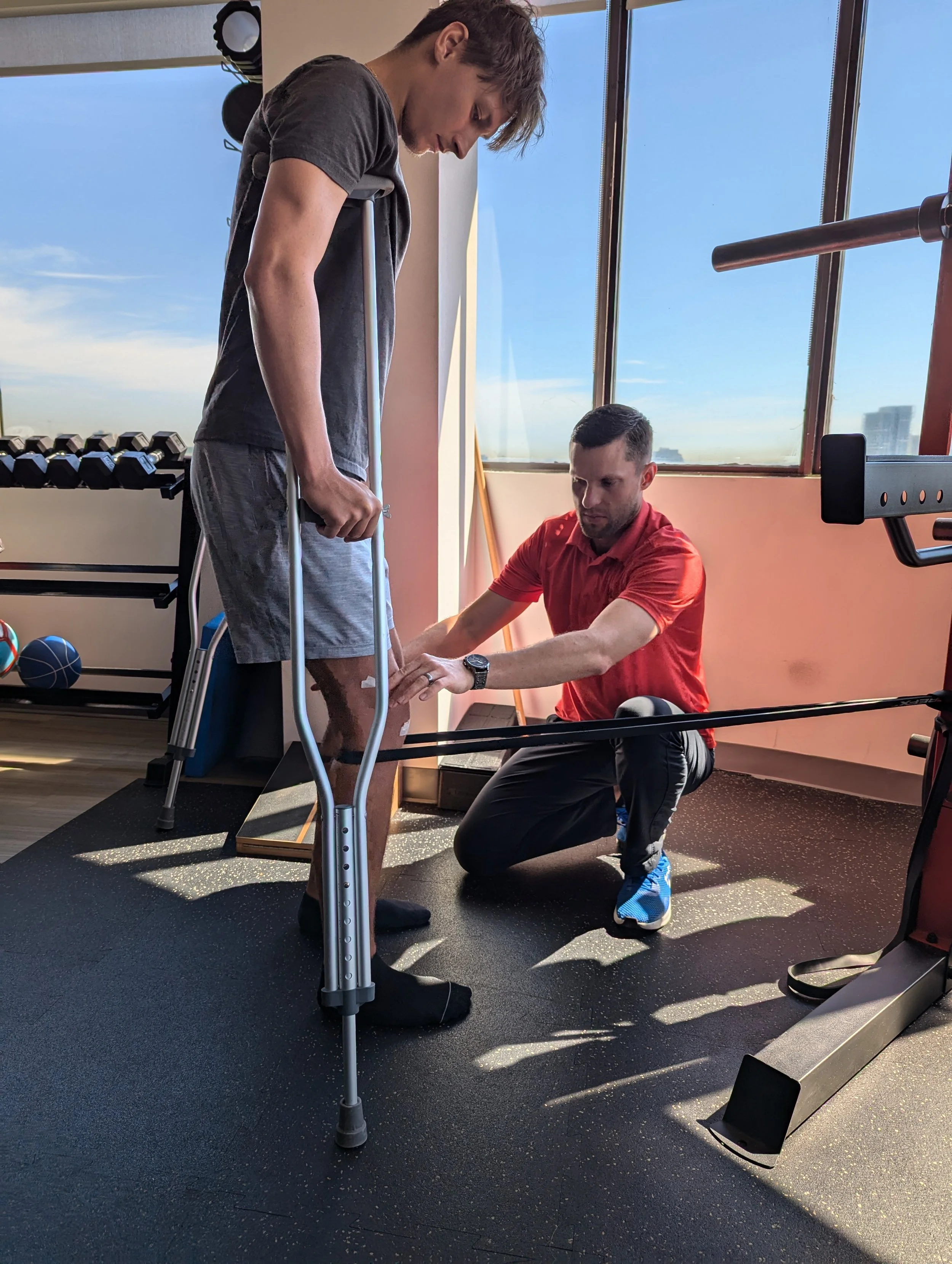
Whether or not you ultimately have surgery, the first 6–8 weeks after an ACL tear follow the same path at our clinic. We call it prehab — and it's one of the most important things you can do regardless of which direction you go.
Prehab involves reducing swelling, restoring full range of motion, and rebuilding quad and hip strength before any surgical decision is finalized. The research is clear: patients who go into ACL surgery with a strong, mobile knee have significantly better outcomes than those who operate immediately on a stiff, atrophied joint.
So even if you're certain you want surgery, starting physiotherapy now isn't wasting time, it's setting you up for the best possible recovery.
THE "WAIT AND SEE" TRAP
One of the most common mistakes we see is patients doing nothing for weeks after an ACL tear - waiting for a surgical consult, resting completely, letting the quad shut down. Those weeks of inactivity cost you significantly in recovery time whether you have surgery or not. Early physiotherapy is never wasted.
The Timeline: Surgery vs. Conservative
One practical consideration that surprises many patients: the recovery timelines are not as different as you might expect. ACL reconstruction typically requires 9–12 months before safe return to cutting sport - and a well-managed conservative program takes a similar length of time to complete the strengthening and neuromuscular training required to return safely.
Surgery is not a shortcut. It's a different path to the same destination, and for the right patient, it's the better path.
The Question We Actually Start With
When a new ACL patient comes into our Oakville clinic, we don't start by asking "surgery or no surgery?" We start by asking: What does this person want their life to look like in 12 months?
The answer to that question - not the MRI report alone - drives the conversation. Our job is to give you the information, the assessment, and the honest clinical perspective you need to make the right decision for you.
Just Torn Your ACL? Start Here.
Don't wait for a surgical consult to begin your recovery. Book an ACL assessment at our Oakville clinic - we'll assess your knee, explain your options clearly, and get you started on prehab right away so you're ahead no matter which path you choose.
Book Your Free Discovery Visit
Or call us at (289) 835-2949
710 Dorval Drive #520, Oakville
